
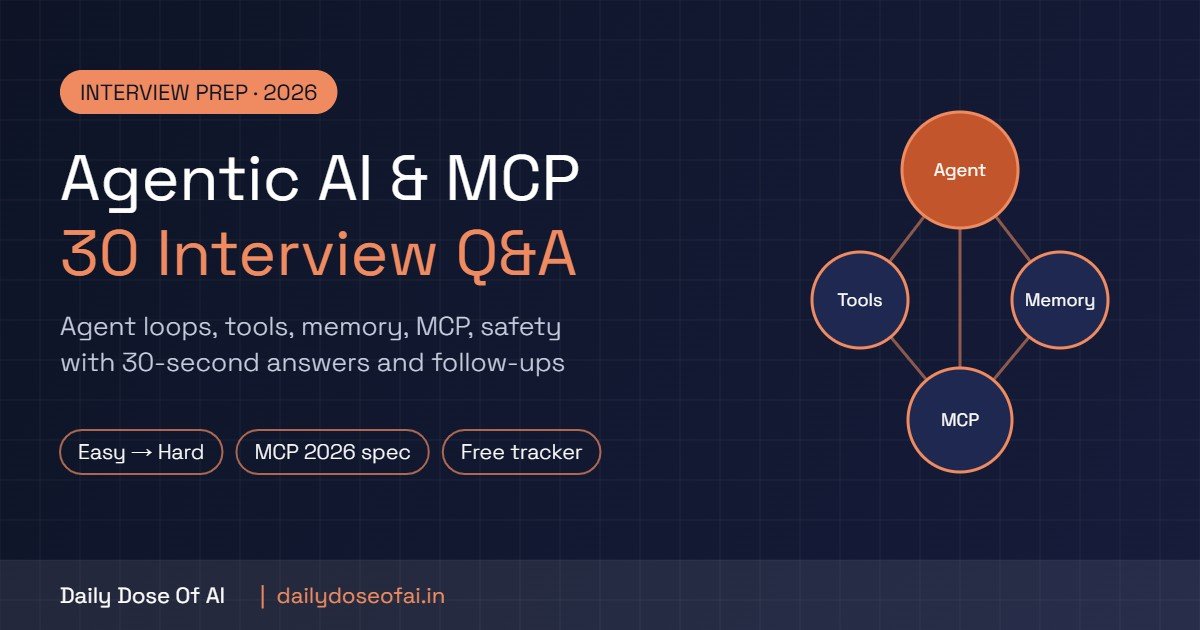
Quick answer: these are the 30 Agentic AI and MCP interview questions that matter most in 2026, from what an agent actually is to tool calling, memory, multi-agent design, the Model Context Protocol, safety and evaluation. Every question has a 30-second answer, a deeper answer, what the interviewer is really testing and the likely follow-up.
Part of our free AI Interview Prep Hub. Tick questions as you master them, and your progress shows up on the hub.
Last updated: November 2026
Agent fundamentals
What is an AI agent, and how is it different from a chatbot?
Show answer
⏱ 30-second answer: An AI agent is an LLM-powered system that works towards a goal by deciding its own next steps, calling tools and observing results in a loop. A chatbot mostly answers one message at a time.
📖 Deeper answer: A chatbot maps an input to a reply. An agent gets a goal (“book the cheapest Delhi-Mumbai flight under Rs 6,000”), plans, calls tools such as search or a booking API, reads the results and keeps going until the goal is met or it needs help. The key ingredients are a model, tools, a loop, memory or state, and a stopping condition.
🎯 What they’re testing: Whether you understand autonomy and the loop, not just the buzzword.
↪ Likely follow-up: When would you NOT use an agent and use a fixed workflow instead?
What is the difference between an agent and a workflow?
Show answer
⏱ 30-second answer: In a workflow the developer fixes the steps in code; in an agent the model decides the steps at run time. Workflows are predictable; agents are flexible but harder to control.
📖 Deeper answer: A workflow might be: classify the ticket, then retrieve docs, then draft a reply, always in that order. An agent receives tools and a goal and picks the order itself, possibly looping. Good practice is to start with the simplest workflow that works and add agent autonomy only where the path genuinely cannot be known in advance.
🎯 What they’re testing: Engineering judgement: choosing the least complex design that solves the problem.
↪ Likely follow-up: Give an example where a workflow beats an agent on cost and reliability.
Explain the agent loop (reason, act, observe).
Show answer
⏱ 30-second answer: The model reasons about what to do, takes an action such as a tool call, observes the result, and repeats until it can give a final answer.
📖 Deeper answer: Each turn, the model sees the goal, the history and previous tool results. It either calls a tool with arguments or returns a final answer. The application executes the tool, appends the result to the context and calls the model again. A maximum number of steps, a budget or a done signal ends the loop so it cannot run forever.
🎯 What they’re testing: Whether you can describe what the application code does versus what the model does.
↪ Likely follow-up: How do you stop an agent that keeps calling the same tool in a loop?
What is the ReAct pattern?
Show answer
⏱ 30-second answer: ReAct (Reason + Act) interleaves short reasoning steps with tool actions and their observations, so the model plans and gathers facts at the same time.
📖 Deeper answer: Instead of answering from memory, the model writes a thought (“I need the latest exchange rate”), takes an action (calls a currency tool), reads the observation and continues. This grounds the answer in real data and makes the trace easy to debug. Modern APIs implement the same idea with native tool calling rather than parsing text.
🎯 What they’re testing: Knowledge of the classic pattern behind most agent frameworks.
↪ Likely follow-up: What are the downsides of ReAct for long, multi-step tasks?
What are the main building blocks of an agent?
Show answer
⏱ 30-second answer: A model, instructions (system prompt), tools, memory or state, and an orchestration loop with guardrails.
📖 Deeper answer: The model does the reasoning. Instructions define the role, rules and output format. Tools let it read and change the world (APIs, databases, code execution). Memory holds conversation history, task state and long-term facts. The orchestrator runs the loop, enforces limits, handles errors and asks a human when needed.
🎯 What they’re testing: Whether you can break an agent into components you could build and test separately.
↪ Likely follow-up: Which of these components causes most production failures, in your experience?
What does “agentic AI” mean in practice for a company?
Show answer
⏱ 30-second answer: It means software that completes multi-step tasks with some autonomy, for example resolving a support ticket end to end, rather than only answering questions.
📖 Deeper answer: Typical uses: support agents that look up orders and issue refunds within limits, coding agents that edit and test code, research agents that search and summarise, and back-office agents that reconcile invoices. Value comes from finishing tasks, but it brings new risks (wrong actions, cost, security), so companies add approvals, limits and audit logs.
🎯 What they’re testing: Business sense: connecting the concept to real value and risk.
↪ Likely follow-up: Which task in a bank or e-commerce company would you automate first with an agent, and why?
When should you avoid building an agent?
Show answer
⏱ 30-second answer: Avoid agents when the steps are known and fixed, when mistakes are very costly, or when latency and cost must be tightly controlled. A simple prompt or workflow is cheaper and more reliable.
📖 Deeper answer: Every extra model call adds cost, latency and a chance of error. If a rule-based pipeline or a single LLM call with retrieval solves the problem, prefer it. Use agents where inputs vary a lot and the path cannot be scripted, and even then constrain the tool set and add checkpoints.
🎯 What they’re testing: Maturity: knowing that “more agentic” is not automatically better.
↪ Likely follow-up: How would you measure whether adding agent autonomy actually improved results?
Want all 30 answers as a printable cheat sheet?
The 30 GenAI questions as a cheat sheet, a system-design framework, a 30-day plan, the STAR method and mock-interview prompts. Printable, and works on mobile.
No spam. Unsubscribe anytime.
Tools & function calling
What is tool calling (function calling)?
Show answer
⏱ 30-second answer: Tool calling lets a model return a structured request to run a function, with a name and JSON arguments, instead of plain text. Your code runs the function and sends the result back.
📖 Deeper answer: You describe each tool with a name, a description and a JSON Schema for its parameters. The model decides whether to call one and fills the arguments. Your application validates them, executes the call, and returns the output as a tool result. The model never executes code itself; your code stays in control.
🎯 What they’re testing: Clear understanding of who executes what.
↪ Likely follow-up: How do you handle a tool call with invalid or missing arguments?
How do you design good tools for an agent?
Show answer
⏱ 30-second answer: Few, focused tools with clear names, precise descriptions, strict input schemas and helpful error messages. Design them for the model, the way you would design an API for a new teammate.
📖 Deeper answer: Prefer task-level tools (get_order_status) over many low-level ones. Write descriptions that say when to use the tool and what it returns. Validate inputs, return concise results (not huge JSON dumps), paginate large outputs, and return errors the model can act on (“order ID must be 10 digits”). Test tools with real model traces and improve descriptions based on mistakes.
🎯 What they’re testing: Practical experience: tool design is one of the biggest levers on agent quality.
↪ Likely follow-up: What would you do if the agent keeps picking the wrong tool between two similar ones?
How do you make tool calls safe?
Show answer
⏱ 30-second answer: Validate every argument, give the agent the least privilege it needs, require human approval for risky or irreversible actions, and log everything.
📖 Deeper answer: Treat model output as untrusted input. Check types, ranges and permissions server-side. Separate read tools from write tools, and gate writes such as payments, deletions or emails behind confirmation. Add rate limits and spending caps, use idempotency keys to avoid double actions, and keep an audit trail of who asked for what.
🎯 What they’re testing: Security mindset with real controls, not vague statements.
↪ Likely follow-up: How would you stop an agent from issuing a refund above Rs 5,000 without approval?
What is prompt injection, and why is it worse for agents?
Show answer
⏱ 30-second answer: Prompt injection is when untrusted content, such as a web page or email, contains instructions that hijack the model. With agents it can trigger real actions, like sending data out or making purchases.
📖 Deeper answer: A chatbot that is injected may say something wrong; an agent with tools may act on it. Indirect injection hides instructions in documents the agent reads. Mitigations: treat all retrieved content as data, keep a clear boundary between instructions and content, restrict tools and destinations, require confirmation for sensitive actions, filter outputs, and limit what data the agent can reach. No single defence is complete, so layer them.
🎯 What they’re testing: Awareness of the number-one security risk in agentic systems.
↪ Likely follow-up: Design a defence for an email-reading agent that can also send emails.
What is structured output, and how does it help agents?
Show answer
⏱ 30-second answer: Structured output forces the model to return data that matches a schema, such as JSON with required fields, so the next step can parse it reliably.
📖 Deeper answer: Agents chain steps, and one malformed output breaks the chain. Schema-constrained output (often called JSON mode or structured outputs) plus validation removes most parsing errors. Keep schemas simple, use enums for fixed choices, and still validate on your side and retry with the error message if needed.
🎯 What they’re testing: Whether you build reliable pipelines, not demos.
↪ Likely follow-up: What do you do when the model’s JSON is valid but the values are wrong?
Planning, memory & multi-agent
How do agents plan multi-step tasks?
Show answer
⏱ 30-second answer: Either plan first then execute (plan-and-execute), or decide one step at a time (ReAct style). Many systems combine both and re-plan when something fails.
📖 Deeper answer: Plan-and-execute writes a task list up front, which is cheaper and easier to review, but can break when reality differs. Step-by-step planning adapts better but can wander. A common design is a planner that writes steps, an executor that runs them, and a check after each step that can trigger a re-plan.
🎯 What they’re testing: Understanding of trade-offs between control and adaptability.
↪ Likely follow-up: How would you show the user the plan and let them edit it before execution?
What types of memory does an agent use?
Show answer
⏱ 30-second answer: Short-term memory is the current context window; long-term memory is stored outside the model, such as a database or vector store, and retrieved when relevant.
📖 Deeper answer: Short-term: the conversation and recent tool results. Working state: the current task, plan and variables. Long-term: user preferences, past interactions or facts, stored as text, structured records or embeddings and fetched by search. Because context windows are limited and cost money, agents summarise or prune old turns and retrieve only what matters.
🎯 What they’re testing: Whether you can design memory that is useful, cheap and private.
↪ Likely follow-up: How would you stop long-term memory from storing sensitive personal data?
How do you manage context in a long-running agent?
Show answer
⏱ 30-second answer: Keep only what the next step needs: summarise old history, store large tool outputs outside the prompt and retrieve them by reference, and reset or compact context at milestones.
📖 Deeper answer: Long agents hit context limits, slow down and get confused by noise. Techniques include rolling summaries, trimming verbose tool results, saving files or notes the agent can re-read, sub-agents with their own clean context for sub-tasks, and clear task state the agent updates. The goal is a small, high-signal context at every step.
🎯 What they’re testing: Senior-level thinking about cost, latency and quality together.
↪ Likely follow-up: What information must never be dropped when you compact the context?
What is a multi-agent system, and when is it worth it?
Show answer
⏱ 30-second answer: Several specialised agents collaborate, for example a researcher, a writer and a reviewer. It is worth it when tasks split cleanly into parallel or very different sub-tasks.
📖 Deeper answer: Benefits: specialised prompts and tools, parallel work and separate contexts. Costs: more model calls, coordination bugs and harder debugging. A single agent with good tools is often enough. Use multiple agents for broad research done in parallel, or when sub-tasks need different permissions.
🎯 What they’re testing: Avoiding complexity for its own sake.
↪ Likely follow-up: How do agents share information without overloading each other’s context?
Compare common multi-agent patterns.
Show answer
⏱ 30-second answer: Orchestrator-worker (a lead agent delegates to helpers), sequential pipeline (each agent hands off to the next), and debate or review (agents critique each other).
📖 Deeper answer: Orchestrator-worker suits open-ended research: the lead splits the task, workers return condensed results. Pipelines suit fixed stages such as extract, transform and validate. Reviewer patterns improve quality by having one agent check another against criteria. Choose by how predictable the task is and how much parallelism helps, and always cap total steps and spend.
🎯 What they’re testing: Breadth of design knowledge and the ability to choose.
↪ Likely follow-up: How would you debug a multi-agent run that produced a wrong final answer?
What is human-in-the-loop, and where do you put it?
Show answer
⏱ 30-second answer: A person reviews or approves the agent’s work at chosen points, especially before irreversible or high-impact actions.
📖 Deeper answer: Typical checkpoints: approving a plan, confirming payments, refunds, emails or deletions, and handling low-confidence cases. Good design makes approval quick (show exactly what will happen) and logs the decision. Over time, low-risk actions can be automated as trust grows.
🎯 What they’re testing: Practical safety design that does not kill usability.
↪ Likely follow-up: How would you decide which actions need approval?
Model Context Protocol (MCP)
What is the Model Context Protocol (MCP)?
Show answer
⏱ 30-second answer: MCP is an open standard for connecting AI applications to external tools and data. A tool built once as an MCP server can be used by any MCP-compatible app.
📖 Deeper answer: Anthropic introduced MCP in November 2024, and in December 2025 donated it to the Agentic AI Foundation under the Linux Foundation. It is often compared to USB-C for AI: instead of writing custom integrations for every app and every tool, both sides speak one protocol. Apps such as Claude, ChatGPT, Cursor, VS Code and Microsoft Copilot support it.
🎯 What they’re testing: Whether you know the current standard for agent integrations.
↪ Likely follow-up: What problem did teams face before MCP existed?
Explain the MCP architecture: host, client and server.
Show answer
⏱ 30-second answer: The host is the AI application, the client is the connector inside the host that talks to one server, and the server exposes tools, resources and prompts.
📖 Deeper answer: For example, a desktop AI app is the host. For each connected integration (GitHub, a database, Google Drive) it creates a client, and each client talks to one MCP server. Messages use JSON-RPC 2.0. This keeps integrations isolated, so one server cannot see another’s data through the protocol.
🎯 What they’re testing: Precise vocabulary and the reason for the separation.
↪ Likely follow-up: Why does one host create a separate client per server?
What do MCP servers expose?
Show answer
⏱ 30-second answer: Three main primitives: tools (actions the model can call), resources (data or context to read) and prompts (reusable templates or workflows for users).
📖 Deeper answer: Tools are model-controlled functions with input schemas, like create_issue. Resources are application-controlled context such as files or records, identified by URIs. Prompts are user-controlled templates, often shown as slash commands. Clients can also offer features to servers, such as elicitation (asking the user for missing information), sampling (requesting a model completion) and roots (which folders the server may work in).
🎯 What they’re testing: Depth beyond “MCP is for tools”.
↪ Likely follow-up: When would you expose something as a resource rather than a tool?
What transports does MCP support?
Show answer
⏱ 30-second answer: stdio for local servers launched as a subprocess, and Streamable HTTP for remote servers.
📖 Deeper answer: With stdio, the host starts the server process and exchanges newline-delimited JSON-RPC messages over standard input and output, which is simple and private. Streamable HTTP sends each message as an HTTP POST to one endpoint, with replies as JSON or a streamed response, which suits hosted, multi-user servers. Older SSE-based remote transports are legacy.
🎯 What they’re testing: Practical deployment knowledge.
↪ Likely follow-up: How would you choose between a local and a remote MCP server for a company tool?
How has MCP evolved, and what changed in the 2026 specification?
Show answer
⏱ 30-second answer: The 2026-07-28 revision makes MCP stateless: every request carries its own protocol version and client capabilities, instead of relying on an initialize handshake and a connection session.
📖 Deeper answer: Earlier revisions opened a session with an initialize handshake and let servers send requests to clients. In the 2026-07-28 spec, each request is self-contained, which makes servers easier to scale behind load balancers. When a server needs user input or a model completion, it returns an input-required result and the client sends a follow-up request (multi round-trip requests). Optional extensions add features such as long-running tasks and interactive UI. Implementations still interoperate with older versions by detecting the counterpart and falling back.
🎯 What they’re testing: Whether you follow the protocol as it changes, not just tutorials from 2024.
↪ Likely follow-up: Why does statelessness matter when you run MCP servers at scale?
How do you secure an MCP integration?
Show answer
⏱ 30-second answer: Use OAuth-based authorization for remote servers, least-privilege scopes, user consent before tool use, input validation, and treat tool descriptions and outputs from untrusted servers as untrusted.
📖 Deeper answer: Risks include a malicious or compromised server (tool poisoning), prompt injection through returned content, over-broad tokens and leaking data between servers. Controls: install only trusted servers, pin versions, review tool lists, scope tokens narrowly, keep credentials in the environment for local servers, require confirmation for sensitive tools, and log tool calls. The spec itself says hosts must get user consent before invoking tools.
🎯 What they’re testing: Security depth on a topic many candidates skip.
↪ Likely follow-up: What is tool poisoning, and how would you detect it?
How is MCP different from A2A (Agent2Agent)?
Show answer
⏱ 30-second answer: MCP connects an agent to tools and data; A2A lets separate agents discover each other and collaborate. They are complementary.
📖 Deeper answer: A2A was launched by Google in April 2025 and moved to the Linux Foundation in June 2025. Agents publish what they can do, and other agents can hand them tasks without seeing their internal prompts. A system might use MCP inside each agent to reach databases and APIs, and A2A between agents owned by different teams or companies.
🎯 What they’re testing: Clarity on the emerging protocol landscape.
↪ Likely follow-up: Describe a system that would use both MCP and A2A.
Safety, evaluation & production
How do you evaluate an AI agent?
Show answer
⏱ 30-second answer: Measure task success on a test set of realistic tasks, plus cost, latency, number of steps, tool-error rate and safety violations. Review full traces, not just final answers.
📖 Deeper answer: Build a dataset of tasks with clear success criteria, run the agent repeatedly (results vary run to run), and score with code checks where possible and LLM-as-a-judge or humans where needed. Track per-step metrics such as wrong tool chosen or invalid arguments. Re-run the suite on every prompt, tool or model change to catch regressions.
🎯 What they’re testing: Whether you can prove an agent works, not just demo it.
↪ Likely follow-up: Why is evaluating agents harder than evaluating a single LLM call?
What are guardrails for agents?
Show answer
⏱ 30-second answer: Checks that keep an agent within safe and allowed behaviour: input filters, output filters, tool permissions, spending and step limits, and human approval for risky actions.
📖 Deeper answer: Guardrails work at several layers: before the model (block harmful requests, strip secrets), at tool time (allow-lists, argument validation, rate limits), and after the model (check for personal data leaks, policy violations or unsupported claims). They should fail safely, explain why something was blocked, and be logged for review.
🎯 What they’re testing: Layered, practical safety thinking.
↪ Likely follow-up: How do you stop guardrails from blocking too many legitimate requests?
How do you control the cost and latency of an agent?
Show answer
⏱ 30-second answer: Use the smallest model that works for each step, cap steps and tokens, cache repeated results, trim context, run independent tool calls in parallel, and route easy tasks away from the agent.
📖 Deeper answer: Cost grows with steps multiplied by context size. Tactics: a cheap router model, a strong model only for hard reasoning, prompt caching for long fixed instructions, summarised history, smaller tool outputs, early stopping when the goal is met, and budgets per task. Measure cost per successful task, not per call.
🎯 What they’re testing: Production and business awareness.
↪ Likely follow-up: Your agent costs Rs 40 per ticket and the target is Rs 10. What do you change first?
How do you debug and observe agents in production?
Show answer
⏱ 30-second answer: Log full traces: every model call, tool call, argument, result, token count and latency, linked by a trace ID, then review failures and turn them into test cases.
📖 Deeper answer: Use tracing (OpenTelemetry-style spans or an LLM observability tool) so you can replay a run step by step. Track dashboards for success rate, cost, latency and errors. Sample traces for human review, label failure types (wrong tool, bad plan, hallucinated argument), fix the cause in prompts or tools, and add the case to the evaluation set.
🎯 What they’re testing: Real operational experience.
↪ Likely follow-up: What personal data would you mask in logs, and how?
Design an AI agent for a bank that answers customers and can block a lost card.
Show answer
⏱ 30-second answer: A tool-using agent with read tools (balance, recent transactions) and one tightly guarded write tool (block card), strong authentication, confirmation before blocking, and hand-off to a human for anything else.
📖 Deeper answer: Flow: authenticate the user in the app (not in chat), classify intent, answer FAQs with retrieval over approved policy documents, and call read-only tools for account questions. For a lost card, show exactly which card will be blocked and ask the user to confirm, then call block_card with an idempotency key and log it. Guardrails: no other write actions, mask card numbers, an injection-resistant system prompt, rate limits and Hindi or English support. Evaluate on test conversations, including attacks, and monitor escalations and wrong blocks.
🎯 What they’re testing: End-to-end design: safety, UX, compliance and evaluation together.
↪ Likely follow-up: How would you change the design if the bot also had to dispute a transaction?
Go deeper with the AI Interview Pro Kit
150 questions with model answers and follow-ups, plus 8 full GenAI system-design walkthroughs. Plus 5 portfolio project playbooks, a resume & LinkedIn kit, company-style rounds and a 30-day plan. PDF + web.
🤖 Practice with AI: free mock interview
Copy this prompt into Claude or ChatGPT and get interviewed. Answer by typing or voice.
Act as a senior interviewer for an Agentic AI Engineer role at an Indian product company. Ask me one question at a time from these topics: agent loops, tool calling, planning and memory, multi-agent design, the Model Context Protocol (MCP), safety and evaluation. Start easy and increase difficulty based on my answers. After each answer: score it out of 10, tell me what was missing, and show a model answer in under 120 words. After 8 questions, give me my strongest and weakest areas and a 7-day study plan.
How to prepare in 7 days
- Day 1: Agent fundamentals (Q1-Q7). Explain the agent loop out loud in one minute.
- Day 2: Tools and function calling (Q8-Q12). Build one agent with two tools in Python.
- Day 3: Planning, memory and multi-agent design (Q13-Q18).
- Day 4-5: MCP (Q19-Q25). Connect an MCP server to Claude using our setup guide, then build a tiny server.
- Day 6: Safety, evaluation and production (Q26-Q29).
- Day 7: Practise the design question (Q30) and do two AI mock interviews with the prompt above.
Tips that make you stand out
- Tell project stories: one real project with numbers beats any textbook definition.
- Talk trade-offs: cost, latency, quality and safety. Senior interviewers listen for this.
- Say “it depends”, then explain on what: it shows judgement, not indecision.
- Show you build safely: mention evaluation, guardrails and monitoring without being asked.
Keep going
Next, set up MCP hands-on with our MCP server setup guide, revise the basics in Basics of Agentic AI and building blocks of AI agents, and practise the 30 Generative AI interview questions.