
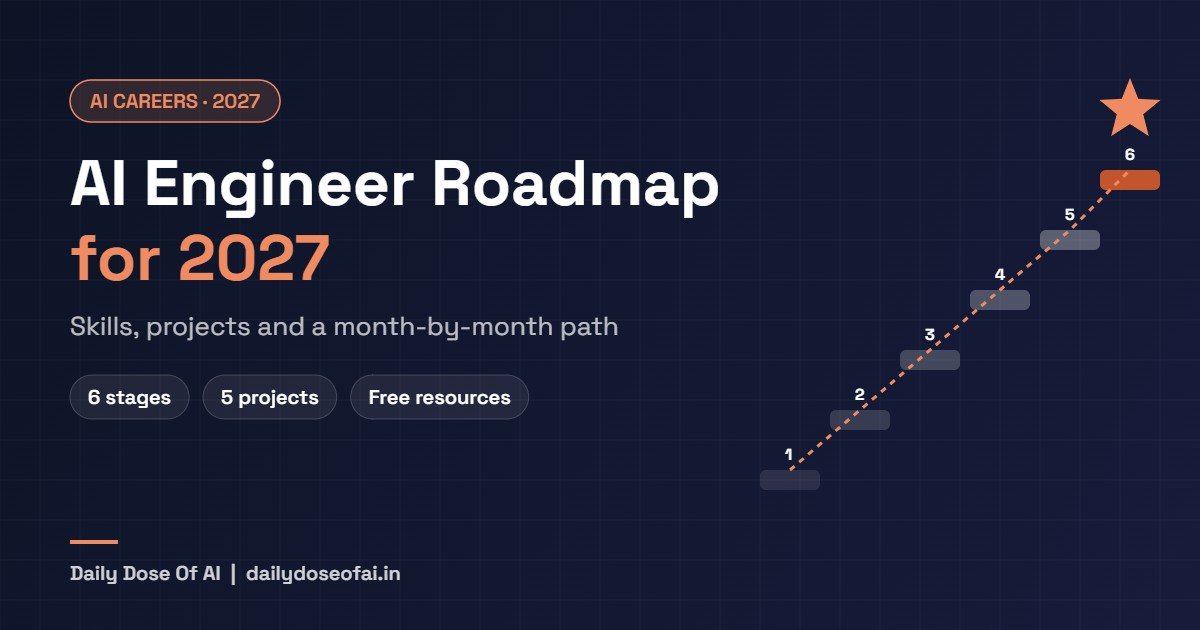
Quick answer: to become an AI engineer by 2027, learn in six stages. Start with Python, then LLM basics and APIs, then prompting and RAG, then AI agents and MCP, then deployment and evaluation, and finally a portfolio of 3 to 5 real projects. With 10 to 12 hours a week, most students and working professionals can get job-ready in 9 to 12 months. You don’t need a PhD or an expensive course; you need projects people can click on.
What does an AI engineer actually do in 2026?
An AI engineer builds products using AI models. They don’t usually train giant models from scratch. Think of a chef: the AI engineer doesn’t grow the wheat (that’s the research scientist). They take good ingredients (models like Claude, GPT, Gemini or open-source LLMs) and cook something customers want: a support chatbot, a document search tool, or an agent that books meetings.
| Role | Main work | Core skills |
|---|---|---|
| AI engineer | Builds apps and agents on top of LLMs | Python, APIs, RAG, agents, deployment, evaluation |
| ML engineer | Trains and serves ML models | Python, PyTorch, MLOps, data pipelines |
| Data scientist | Finds insights and predicts from data | Statistics, SQL, pandas, visualisation |
| Research scientist | Invents new models/methods | Deep maths, papers, large-scale training |
Good news for Indian freshers and IT professionals: the AI engineer path leans on software skills you can learn fast, not years of maths.
The 6-stage AI engineer roadmap
Stage 1: Python and programming basics (Months 1–2)
- Variables, loops, functions, lists/dicts, files, error handling
- Virtual environments,
pip, Git and GitHub - Working with JSON and calling a web API using
requests - Milestone: a CLI tool that fetches live data (for example, cricket scores or weather) and saves it to a file.
Stage 2: How LLMs work + calling them by API (Month 3)
- Tokens, context window, temperature, hallucination. Start with What is a Large Language Model.
- Call an LLM from Python using a free API key. Use our free LLM API guide.
- Structured output (JSON), streaming, handling errors and rate limits
- Milestone: a resume-feedback bot that returns JSON scores.
Stage 3: Prompt engineering + RAG (Months 4–5)
- Clear instructions, examples (few-shot), role and format control
- Embeddings, vector databases, chunking and retrieval: RAG lets the model answer from your documents
- Milestone: “Chat with your college syllabus PDF” or “HR policy assistant”.
Stage 4: AI agents, tools and MCP (Months 6–7)
- Tool calling: let the model run functions (search, calculator, database)
- Agent loops, memory and planning. Read Building blocks of AI Agents.
- MCP, the standard way to connect AI to tools. See our MCP server setup guide.
- Use coding agents (Claude Code, OpenCode, Antigravity) to build faster, and learn to review their code.
- Milestone: an agent that reads emails/notes and creates a to-do list in a sheet.
Stage 5: Deployment, evaluation and cost (Months 8–9)
- Build an API with FastAPI and a simple UI (Streamlit or a basic web page)
- Deploy to a cloud or VPS; use environment variables for keys (never commit keys to GitHub)
- Evaluate: create 20–50 test questions and measure accuracy before and after each change
- Track cost and latency; cache repeated answers
Stage 6: Portfolio + job hunt (Months 10–12)
- 3–5 deployed projects with live links, READMEs and a 2-minute demo video each
- Write about what you built (a blog or LinkedIn posts). Recruiters notice explainers.
- Apply for roles titled AI Engineer, GenAI Developer, LLM Engineer, Applied AI Engineer and AI Solutions Engineer
5 portfolio projects that get interviews
- RAG on Indian documents: ask questions about RBI circulars, a university handbook or company policies, with source citations.
- WhatsApp-style support bot: answers FAQs for a local business, hands off to a human when unsure.
- Multi-step agent: researches a topic, drafts a report and emails it, with logs showing each step.
- Evaluation dashboard: compares two prompts or models on 50 test questions (accuracy, cost, speed).
- MCP server: connects an AI assistant to a real tool (Google Sheets, a database, Jira).
Why these work: each one shows a skill interviewers ask about (RAG, agents, evaluation, integration) and solves a believable business problem.
Free resources to follow
- Python: the official Python tutorial at docs.python.org, plus daily practice on a coding site
- LLM APIs: official docs from Anthropic (docs.claude.com), Google AI Studio and OpenAI, all with free quickstarts
- Deep learning intuition: fast.ai and the Hugging Face courses (free)
- Agents/MCP: modelcontextprotocol.io docs and the examples in this blog’s Agents category
- Old roadmap, still useful: our GenAI developer learning path
Common mistakes to avoid
- Course hoarding: 10 certificates and no projects. One deployed project beats five certificates.
- Skipping Python: no-code tools are great, but interviews test coding.
- Only using ChatGPT’s UI: companies hire people who can build with APIs, not just chat.
- Ignoring evaluation: “it worked on my 3 examples” isn’t engineering.
- Copy-pasting AI code you don’t understand: you will be asked to explain it in the interview.
FAQ
Can a non-CS graduate become an AI engineer? Yes. Many come from mechanical, commerce or support backgrounds. The portfolio matters more than the degree for many startups; larger companies may still filter by degree.
Do I need advanced maths? Not for most AI engineer roles. Basic statistics and an intuitive understanding of embeddings is enough to start. ML research roles are different.
Is AI engineering safe from AI itself? AI tools write more of the code each year, but someone still has to design, connect, evaluate and own AI systems. That is exactly this role.
Which language: Python or JavaScript? Start with Python. Add JavaScript/TypeScript later for web apps.
Your next step
Today, set a 12-month calendar with the six stages above and finish one tiny Stage 1 project this week. Then bookmark our AI Careers & Interview Prep section; we add interview questions and project guides every week.